What You Have Learned About Integrating Social Studies Into Language Arts

(This is the first post in a two-part serial)
The new question-of-the-calendar week is:
What are the best ways to integrate writing in social studies classes?
In schools, all of us need to exist writing teachers, incuding those of u.s.a. who teach social studies. This series will explore specific means to integrate writing in social studies classes.
In add-on to the ideas discussed by contributors to this two-part series, yous might also desire to explore The All-time Resources For Writing In Social Studies Classes, The Best Scaffolded Writing Frames For Students, and previous columns actualization hither on Writing Instruction and on Educational activity Social Studies.
Today, Stan Pesick, Ben Alvord, Dawn Mitchell, Rachel Johnson, and Rebecca Testa-Ryan share their suggestions. You can heed to a 10-infinitesimal conversation I had with Stan, Ben, Dawn, and Rachel on my BAM! Radio Show. You lot tin also find a list of, and links to, previous shows here.
Response From Stan Pesick
Stan Pesick currently works with both the Bay Area (California) and National Writing Projects and the Lesson Study Group at Mills College, Oakland, Calif. He taught American history and American government/economics in the Oakland Unified school commune (OUSD) for 18 years (1976 - 1994). Betwixt 2001 and 2013, he co-directed OUSD's History/Social Studies Department and its programs focused on curriculum and professional development. Since 2014, he's also worked as a curriculum consultant to the National Japanese American Historical Social club and teh National Park Service:
Below are three ideas that can help students develop the skills and understandings necessary for writing, and have something meaningful to say, in history-social-studies classes.
I. History every bit Inquiry
If writing is actually thinking, it'southward best integrated into history-social-studies classes when connected to specific ideas, events, and people at the heart of what is beingness studied. For writing to exist meaningful and engaging, it has to be near something and supported past teaching that unites the writing and the content. A first step in that procedure is developing good inquiry questions that frame lessons, units of instruction, and investigations.
What makes a proficient inquiry/argumentative writing prompt?
- Generates discussion and encourages varied points of view.
- Demands an respond that is not just a simple yeah or no.
- Demands a critical or careful reading of the text(s).
- Moves beyond opinion, into positions that connect claim, show, and reasoning
II. Working With Models
In history-social-studies classrooms, students can be asked to write in a variety of ways, including narratives, explanations, interpretations, and evidence-based arguments but may not often get a adventure to actually read the kinds of writing they are asked to produce. A common activity in history these days has students working with primary-source documents and brief background pieces, including a textbook excerpt, that provide some context on the time and identify where the sources were created. Merely a source document is just a piece of the past to be analyzed and interpreted; it is not written history, and a brief groundwork slice or a textbook excerpt is most oft not a good example of well-written history.
Students need to read and discuss good examples of the kind of writing we are looking for; we need to make visible what nosotros have in heed. For students to understand how to construct a historical account, they need the opportunity to talk over, analyze, and appreciate well-written history. Consider this historical narrative and interpretation the historian Nell Painter uses to begin her book, Exodusters (kickoff with link to Page iii and read through "no longer..." towards the bottom of Page 5) . As you read, consider how the post-obit questions might assist students better understand what comprises quality historical writing.
- Who were the Exodusters, and why does Nell Painter write nearly them?
- How does the cursory narrative about the Solomon family unit assistance you understand what's happening in this place and fourth dimension?
- What statement is Painter making about the hopes and dreams of African-Americans in post-Civil State of war America?
- What are the fundamental pieces of evidence Painter uses to support her arguments effectually Reconstruction and the hopes and dreams of African-Americans?
- What questions do y'all have about the content of this slice? What more practise you want to know?
3. Notation: Writing that prepares for writing
Working with source documents, equally role of work within an academic subject field such as history, economics, or geography, requires a specific kind of conversation between reader and text. In history, this conversation begins with "sourcing" questions, which ask the reader to read "around" the historical text, noting time, identify, authorship, and other information well-nigh the text's origins and historical context. It is then connected with a shut examination and conversation with the text itself. What information, perspectives, ideas, and questions are communicated and raised?
Below is an example of what an "notation guide" for working with historical sources might focus on in preparing a student to read and analyze an historical source. Information technology tin can hands be adapted for the reading of source documents connected to other subjects and disciplines.
A Guide to Annotating in History
Identify, comment on, or question the words, ideas, and/or perspectives that:
- Provide information on who created the document, when, where, and for what audience;
- Illustrate how the creator of the certificate might accept viewed the historical question, upshot, or individual at the center of your historical inquiry;
- Provide insight into what reasoning yous will use to clarify the documents and develop your argument; i.e., criteria-based evaluation, cause and issue, cost-do good, illustration
- You volition utilize to support the argument you develop in response to the inquiry question;
- You disagree with and will demand to counter equally y'all develop your argument in response to the enquiry question.
- Intrigue, confuse, or trouble you?

Response From Ben Alvord
Benjamin D. Alvord is a 7th and eighth grade history teacher in Utah's Tooele County school district and a Hope Street Group/NNSTOY Utah Teacher Beau:
Moving from Students to Historians
Social studies is under attack in the educational activity globe. This is not a revelation to teachers of this discipline, but as the required courses are whittled away in many states, we have to fight against this and confronting students who don't share the same passion for history that we practice. One style to do this is to turn your students into historians.
A smashing way to make students historians is to accept them reply a historical question in your class. The Stanford History Education Group, or SHEG (sheg.stanford.edu), has created many lesson plans that have this premise. Ane of these is the "Battle of Lexington" lesson plan. Like many other things in history, there are open questions regarding this battle. This lesson centers around the question of "Which side shot first?".
Asking students to provide an answer, in the right style, to questions that remain unanswered makes them historians. Provide your students relevant primary sources that bear witness multiple accounts of the aforementioned incident and allow them to detect the answers on their own. Of course, to exercise this, you will have to provide them with some skills.
Utah and many other states are moving their standards from content-based standards to skills-based standards post-obit the C3 Framework provided by the National Quango for the Social Studies. Many of the skills listed in these frameworks are the skills y'all would use in a lesson program such as the "Battle of Lexington" and other SHEG lesson plans. For this lesson, students will need to know sourcing, corroboration, and contextualization. SHEG as well provides lesson plans to help teach your students these skills. Once the students accept these skills, they can show them off by writing an essay.
Another do good of a lesson like this is that information technology lends itself easily to another important job in education, which is integrating writing into your curriculum. The best style for the students to reply an open historical question is with an argumentative essay. The students are then forced to identify the results of their sourcing, corroboration, and contextualization. This can be done at whatsoever level. I frequently hear from my unproblematic school peers that they have little time to teach social studies in their classroom. A lesson similar this allows yous to teach social studies while teaching a linguistic communication arts lesson. You tin can also scaffold lessons like this for younger students past rewriting primary sources into more accessible language while keeping the original intent. Students no matter what level dear to argue.
Another upshot we deals with as social studies teachers is aloofness in our students. When you allow students to find answers on their own rather than giving them the respond, it allows them to accept that moment of discovery that can appoint them. Moments of discovery are what drew us in to being lovers of history, and it tin can exist the same for our students.
As social studies teachers, nosotros take to step up and defend our subject from the attack it is under. To do this, we accept to be willing to adapt to a changing globe and irresolute priorities in the world of education. Integrating skills-based lessons and writing into our curriculum is a great way to practise that.

Response From Dawn Mitchell & Rachel Johnson
Rachel Johnson has taught social studies at the elementary and middle schoolhouse level for the last thirteen years. Currently, she teaches seventh class social studies at Fairforest Heart Schoolhouse in Spartanburg Commune Six in Spartanburg, Southward.C. Rachel continually serves on several social studies committees for the S.C. education department and provides professional-evolution opportunities in social studies for teachers. Connect with Rachel on twitter @RachelJ62201984
Dawn Mitchell serves in instructional services in Spartanburg District 6, where she leads the consecration and mentoring program besides as provides professional development in literacy and in project- based learning. Dawn is too an adjunct instructor at Furman Academy, where she currently serves as a university supervisor and teacher mentor. Connect with Dawn on twitter @dawnjmitchell:
Prove What You lot Know: Using Principles of Visible Learning to Integrate Writing Into Social Studies
Effective teachers of social studies view writing as a natural and necessary tool for learning. When we integrate writing within the bailiwick of social studies, we are using it equally a fashion for students to show what they are learning. Just equally historians would, students are using disciplinary writing to build inquiry and knowledge of the given time frame and topic. This approach to writing isn't an additional assignment. Instead, it is a pathway toward increased student interest, enquiry, and appointment non but in the activity or the product just also in the accurate procedure. Through using principles of visible learning, students become agile learners in the social studies classroom, not merely passive paragraph writers or test-takers.
1.) Claim/Support/Question with Primary Source Analysis—One of the most engaging means to build interest and groundwork knowledge in social studies is to have students experience the topic from viewing master sources from the fourth dimension period. Rachel writes, "In my classroom, students analyze principal sources such equally pictures, political cartoons, letters, maps, propaganda posters, just to name a few." I accept found when I have my students analyze primary sources at the starting time of a unit of measurement, they actually build a sincere interest in the topic of study that has been built from their primary-source inquiry and assay. After the initial viewing, I have students write downward their wonderings/findings. They write downwards what they notice, what the main source prompts them to question/wonder, and what they infer the historical context is. One of our favorite principal-source analysis tools is from the American Library of Congress. Click here to view: Primary Source Analysis Tool.
Example (children playing amongst the ruins in East Berlin):

Photo Credit: Digital Public Library of America

ii.) Connect/Extend/Challenge with Exit Slips—Determinative assessments are a keen way of knowing what your students learned and to gauge pacing for upcoming lessons. 1 digital exit skid tool is Connect/Extend/Challenge. Through this exit slip, students are able to connect learning from the contempo lesson to previous learning. They are able to consider what they learned that extended/changed/or challenged their learning besides every bit whatever new questions they may take. Rachel writes, "Non all exit slips are this extensive. Many times I will use a backchannel similar TodaysMeet or a padlet with open up-concluded questions specific to that twenty-four hours'south content that I want to notice out students' responses to in order to determine student understanding. For case, 1 that I accept used often with United States history is "What is something that we talked about that yous call back will have an consequence on hereafter events in our land's history?" Typically, my exit slips are targeted to a specific skill or concept that I want to make sure students grasp. Not only are their responses beneficial to me as their teacher, but the process of writing downwardly their thoughts and reading the responses of their peers, allows for their further learning.
Example: Padlet Board
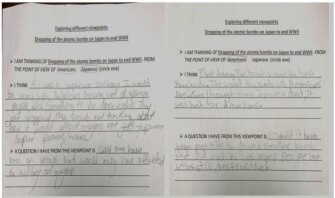
3.) Circle of Viewpoints with Perspectives—Information technology is important when educational activity history to students that they consider multiple perspectives, non just the most popular or common perspective. For instance, if you are education a battle in American history, it is typical for the historical perspective to exist written favorably toward the winner. However, effective teachers of social studies know that all historical accounts are biased and need to be evaluated to place the inherent bias and strive to seek the complete story. Students need to sympathize all aspects of the effect, and this requires them to recognize and value multiple perspectives. Rachel writes, "This arroyo to educational activity social studies is cantankerous-disciplinary as it applies to literacy with point of view, and I argue it is extremely valuable with present-twenty-four hours social interactions with their peers. Imagine how dissimilar our society would be if nosotros all looked at every side of an argument before making a decision." A recent example from my classroom was when we talked about the ending of WWII in the Pacific Front. It is very easy to come across the dropping of the atomic bomb from the American point of view; still, I challenge students to think about this upshot from the Japanese perspective. We discuss the Japanese mentality of "Never surrender" every bit function of their culture, and surrendering to the Centrolineal forces was not an option. To help students sympathize this event and the Japanese perspective, I chose a read-aloud. Shin's Tricycle , which narrates the true account of a iii-yr-old victim of the Hiroshima bombings. Students then visit the website of the Peace Museum to see actual photographs of Shin and his tricycle."
Case:

Response From Rebecca Testa-Ryan
Dr. Rebecca Testa-Ryan is a Latina educator who has worked for the the Chicago public school district for 23 years. Rebecca received her doctorate degree from Loyola Academy in curriculum and educational activity, a master'south degree in special education and administration, and a bachelor's in history. She grew up in Humboldt Park and has taught in that commune to model the importance of leading by instance:
I accept been a social studies instructor for 23 years and I take developed my teaching beyond presenting concepts of authorities, geography, history, economics, and current events. In my view, the teaching of social studies is an opportunity to integrate curriculum, such equally writing, to broaden the connection between the content presented and the student experience. Written communication is quite possibly the nigh significant form of expression; the skill to articulate through writing allows each pupil the freedom to share their assay of historical events in a meaningful and effective mode. Every bit an educator, it is my responsibility to assist my students to develop those skills that will enable them to organize their thoughts, formulate arguments, and support ideas. Developing students' writing skills should not be an isolated practice only experienced in a language arts course. In my case, I find various way to comprise writing in social studies to set my students for the transition from centre schoolhouse to high schoolhouse, besides as beyond this, where acquiring written skills is critical.
The simplest way to take daily writing in my social studies course is to make bachelor private copies of primary sources to analyze. The purposeful grouping of students and the usage of advisable academic language to analyze and evaluate sources initiate channels into meaningful accounts of the past. Students learn to listen and observe and value each other's interpretation of sources. Once students have processed the sources visually and exchanged their ideas, it is and then when students will demonstrate their individual experience in written form. Peer to peer interaction and discourse becomes role of the writing process as they engage with the same materials simply have unique points of view.
Every bit nosotros begin the school twelvemonth, I provide my students with framed paragraphs until they are more comfortable with the structure of an bookish paragraph. Once they have developed an agreement of the construction, we go deeper and identify the paragraph's purpose, why the paragraph is relevant, what evidence volition be used to support their argument, how to show the reader that evidence adds to an statement, and how the conclusion shows the significance of the bear witness a author has presented. When I observe students are prepared to take on more, I claiming them by responding to three writing tasks a week. As students meet a slice of work that they have successfully mastered, they feel a sense of confidence and are fix to take on the adjacent challenge.
The concluding writing activity I would similar to share is one my students relish completing. I call it "Wocabulary-Writing and Vocabulary." Depending on the academic level of my students, I provide Tier 1, two, or iii vocabulary words from the historical period we are roofing. I give my students the title of the writing consignment with the list of four, vi, or 10 words placed in the center of the paper. My nonreaders tin also participate by making a story board using illustrations of each vocabulary word and present to the course. Students who are given 10 words can divide the words to make two paragraphs if they wish, but they must make certain the historical account is accurate. They may apply the vocabulary discussion in the beginning, center, or at the end of a sentence. On many occasions, students have properly used three vocabulary words in 1 sentence. The goal of this activity is to force students to think critically, use academic vocabulary appropriately, relish writing, and have some fun during social studies grade.

Thanks to Stan, Ben, Dawn, Rachel, and Rebecca for their contributions!
Please experience costless to leave a comment with your reactions to the topic or directly to anything that has been said in this mail.
Consider contributing a question to be answered in a future mail. Yous tin can send i to me at lferlazzo@epe.org. When you send it in, let me know if I tin employ your real name if it'south selected or if you'd prefer remaining anonymous and have a pseudonym in heed.
Yous can also contact me on Twitter at @Larryferlazzo.
Education Week has published a drove of posts from this web log, forth with new textile, in an e-book form. Information technology'due south titled Classroom Direction Q&As: Skillful Strategies for Teaching.
Simply a reminder; you can subscribe and receive updates from this web log via email or RSS Reader. And if y'all missed any of the highlights from the first seven years of this blog, you tin see a categorized list below. The list doesn't include ones from this current year, merely you can find those by clicking on the "answers" category found in the sidebar.
This Year'due south Nearly Popular Q&A Posts
Race & Gender Challenges
Classroom Management Advice
Best Means to Begin The School Year
Best Ways to Cease The School Year
Implementing the Common Cadre
Pupil Motivation & Social-Emotional Learning
Education Social Studies
Project-Based Learning
Using Tech in the Classroom
Parent Engagement in Schools
Teaching English language-Language Learners
Reading Pedagogy
Writing Educational activity
Pedagogy Policy Issues
Educatee Assessment
Differentiating Instruction
Math Instruction
Science Teaching
Advice for New Teachers
Author Interviews
Entering the Teaching Profession
The Inclusive Classroom
Learning & the Brain
Ambassador Leadership
Teacher Leadership
Relationships in Schools
Professional Evolution
Instructional Strategies
Best of Classroom Q&A
I am also creating a Twitter list including all contributers to this column.
Look for Part Two in a few days.
The opinions expressed in Classroom Q&A With Larry Ferlazzo are strictly those of the writer(s) and practise not reflect the opinions or endorsement of Editorial Projects in Teaching, or any of its publications.
Source: https://www.edweek.org/teaching-learning/opinion-response-ways-to-integrate-writing-in-social-studies-classes/2019/04
0 Response to "What You Have Learned About Integrating Social Studies Into Language Arts"
Post a Comment